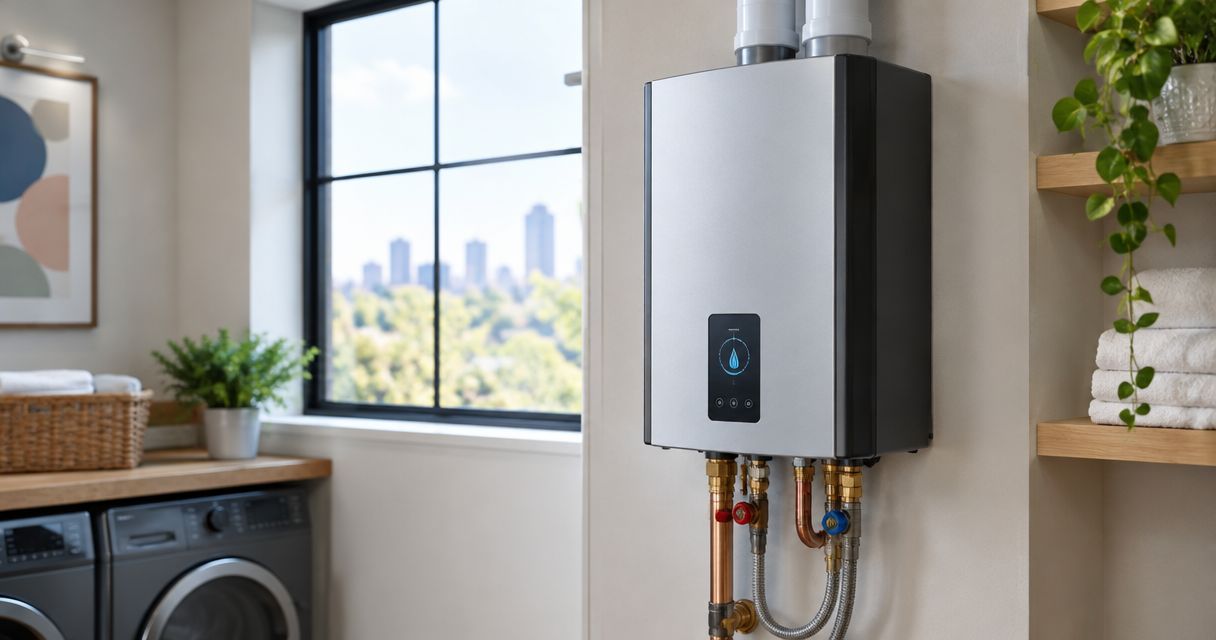
The right water heater size for your Winston-Salem home is the size that meets your busiest hour of hot-water use, not simply the size your neighbor owns. For a tank model, compare the first-hour rating with your household's peak demand; for tankless equipment, compare simultaneous flow and the required temperature rise. Check those needs before replacing a heater that has started running cold.
- Choose water heater size in Winston-Salem by peak demand, not bedroom count alone.
- Tank capacity and first-hour delivery are different measurements.
- Running cold can indicate a repair problem rather than an undersized tank.
- Have a licensed plumber check installation space and utilities before ordering a replacement.
Why this matters before you replace a water heater
Replacing a failed heater creates pressure to make a quick decision. Copying the old tank's gallon capacity feels safe, but the old system might never have served your household well. A remodel, another resident, or a change in shower routines can also change the demand.
The reverse mistake is buying the largest heater that fits through the door. More stored water does not resolve every hot-water complaint, and a physically larger tank can create installation problems. You need a match between delivery, available space, and the way your household actually uses water.
For help assessing a replacement, JJ's Plumbing Y2K provides water heater repair, replacement, and installation in Winston-Salem and surrounding Triad communities. A useful starting point is the symptom you want fixed: not enough hot water, a leak, unreliable temperature, or equipment that no longer works.
What size water heater do you need in Winston-Salem?
Size a storage water heater around the hot water your household needs during its busiest hour. The U.S. Department of Energy's residential sizing guidance identifies first-hour rating as the useful comparison for storage and tank-style heat-pump water heaters. That rating describes delivery during a one-hour period starting with a full tank of hot water.
Tank capacity measures how much water the tank holds. First-hour rating accounts for that stored water and the heater's ability to heat additional water during the same period. Two heaters with similar tank capacities do not necessarily deliver the same first-hour performance.
Use this order when discussing a replacement:
- Describe the busiest hot-water period in your home.
- List the showers, baths, appliances, and other uses that overlap.
- Compare that demand with the proposed heater's first-hour rating.
- Check dimensions, connections, utility requirements, and service access.
- Confirm whether a repair could solve the original complaint.
This is a selection process, not a do-it-yourself installation procedure. Electrical connections, gas work, relief valves, and other safety components belong with qualified professionals.
Tank capacity, first-hour rating, and tankless flow compared
| Measurement | What it tells you | Best use | What it does not tell you |
|---|---|---|---|
| Tank capacity, in gallons | How much water the tank stores | Checking storage volume and comparing physical options | Total delivery during repeated use |
| First-hour rating, in gallons | Hot water delivered during the first hour from a heated tank | Matching a tank heater to peak household demand | Whether the heater fits your installation space |
| Tankless flow, in gallons per minute | Delivery at a stated temperature rise | Checking simultaneous fixture demand | Whole-house performance at every incoming temperature |
| Temperature rise, in degrees Fahrenheit | Difference between incoming and desired water temperature | Evaluating tankless output under the relevant conditions | Electrical, gas, or venting suitability |
For a tank replacement, first-hour delivery is usually more useful than a gallon-size label alone. For a tankless replacement, a large advertised flow number is incomplete without the temperature-rise conditions behind it.
Do not compare the measurements as though they are interchangeable. A storage tank and a tankless unit serve demand differently, even when both can be suitable for the same home.
Start with the busiest hour, not the number of bedrooms
A home's bedroom count is easy to find, but it does not describe its hot-water pattern. A smaller household that takes overlapping showers can place more immediate demand on a heater than a larger household that spreads its use throughout the day.
Walk through a typical busy morning or evening. Note which uses happen together, which could be separated, and which must remain convenient. The goal is to describe normal life honestly, not create an ideal schedule that nobody will follow.
Give your plumber a short list:
- Showers or baths used during the busiest period.
- Appliances that run during that same period.
- Large tubs or unusual fixtures.
- Whether guests regularly add demand.
- Any planned bathroom additions or household changes.
- Whether the current heater ever kept up comfortably.
Do not assume every fixture uses the same amount of hot water. Fixture flow, shower duration, and the mixture of hot and cold water all affect the total. Use actual fixture information when it is available rather than an unsupported household-size chart.
Use the Energy Department's example correctly
The Department of Energy's sizing page gives a worked example with a peak-hour demand of 66 gallons. Its conclusion is that the example household needs a water heater with a first-hour rating of at least 66 gallons.
That is an example of the method, not a 66-gallon recommendation for every home. The important comparison is between that household's calculated demand and the proposed heater's rated delivery. Your household's result can differ.
This distinction prevents a common shopping mistake. A homeowner sees a sizing example, remembers the gallon number, and buys by tank volume. But the example concerns first-hour delivery, which is not the same as the water physically stored in the tank.
When looking at a 2026 replacement proposal, ask the installer to name both measurements. You should be able to explain why the proposed unit meets your demand without relying on the phrase bigger is better.
Running out of hot water does not always mean the tank is too small
A heater that once served the same household comfortably deserves a repair assessment before you assume it needs more capacity. A failing component, sediment, or a plumbing problem can change performance without any change in your daily demand.
Be specific about the pattern. Does the water start hot and then cool unusually quickly? Is one fixture affected, or is the whole house affected? Did the problem appear suddenly, or has it always happened during overlapping use?
These observations help separate sizing from diagnosis:
- Always struggled during overlapping showers: review peak demand and delivery.
- Recently lost performance with unchanged routines: ask about a fault before upsizing.
- Only one fixture behaves differently: include that fixture in the assessment.
- Water appears around the heater: treat the leak as a service issue, not a capacity question.
- Temperature swings without a clear demand pattern: request diagnosis rather than a shopping recommendation.
JJ's Plumbing Y2K offers water heater repair as well as replacement. That matters when your goal is reliable hot water rather than simply owning a larger tank.
Check the installation space before choosing a size
A heater has to fit more than its footprint. The installer needs to consider height, diameter, door access, connections, required clearances, and space for future maintenance. A nominal gallon size does not settle those questions.
A replacement in a tight closet can be a different project from a replacement in an open utility room. Likewise, moving equipment to another location changes the work involved. Let the installer inspect the actual setting before you order a unit online.
Prepare what you can without touching equipment:
- Take a clear photograph of the existing heater and its label.
- Show the route from the entrance to the installation area.
- Note shelves, walls, or storage that restrict access.
- Describe whether the space is conditioned or exposed to outdoor temperatures.
- Mention past leaks or drainage problems around the heater.
Do not remove covers, disconnect wiring, or move safety components to take measurements. A readable label and a clear description are enough to begin the conversation safely.
Tankless sizing is a different decision
A tankless heater must support the fixtures you want to use at the same time. Its output also depends on the difference between incoming water temperature and the required outlet temperature. That is why the maximum flow printed in an advertisement does not answer every household's sizing question.
The Department of Energy's tankless example combines a 0.75-gallon-per-minute faucet and a 2.5-gallon-per-minute shower for a required flow of 3.25 gallons per minute. Those are example fixture demands, not measurements of your bathroom.
Ask the installer to use your fixtures and the relevant incoming-water conditions. Colder incoming water requires more heating to reach the same outlet temperature. That can change the delivery available from a particular unit.
If you are considering a change from a tank, read the tankless water heater guide for Winston-Salem homes. Treat the choice as a system assessment, including utilities and installation, rather than a promise of unlimited output under every condition.
Questions to ask before approving a replacement
You do not need to become a water heater specialist. You do need an explanation that connects the proposed equipment to the problem you reported.
Ask these questions before work begins:
- What is causing the current hot-water problem?
- Is repair a reasonable option for this heater?
- What demand does the proposed replacement cover?
- What are its tank capacity and first-hour rating?
- Does it fit the existing space and utility connections?
- What other installation work is needed?
- What maintenance will the replacement require?
A useful explanation should distinguish the equipment from the installation work. It should also describe meaningful limitations, such as a need to stagger heavy use or a space constraint that rules out an otherwise attractive model.
For Winston-Salem homeowners who need a repair-or-replacement assessment, JJ's Plumbing Y2K provides licensed plumbing service with clear recommendations before repair work begins. Do not select a contractor solely because a proposal lists a larger tank.
FAQ
Can you choose water heater size by household size alone?
Household size is only a starting point. Peak-hour use, overlapping fixtures, and the heater's rated delivery determine whether it can serve your routines.
Is first-hour rating the same as tank capacity?
No. Tank capacity measures stored water, while first-hour rating describes delivery over an hour starting with a full heated tank.
Does a bigger tank always fix running out of hot water?
No. A heater that recently lost performance can have a repair problem, and a larger tank does not fix every equipment or plumbing fault.
Should I buy the same size as my old water heater?
Not without reviewing how the old heater performed. Changed household demand, installation space, and the proposed replacement's delivery rating all matter.
How do you size a tankless water heater?
Size a tankless heater by simultaneous hot-water flow and the required temperature rise. Ask the installer to use actual fixture demands and relevant incoming-water conditions.
What should I tell a plumber before a water heater visit?
Describe leaks, temperature changes, overlapping hot-water use, and whether the heater previously kept up. Provide a label photograph if you can take it safely.
Who can help assess a water heater in Winston-Salem?
JJ's Plumbing Y2K provides water heater repair, replacement, and installation in Winston-Salem and the surrounding Triad. Ask for a diagnosis and sizing explanation before choosing equipment.
One last thing
Bring your routine, not just your tank label, to the replacement conversation. The label identifies the old equipment. Your busiest hour explains what the new equipment must do.
The technical examples in this 2026 guide come from the U.S. Department of Energy's residential water heater sizing guidance. They explain the selection method; they are not a measurement of your house or a substitute for an on-site assessment. JJ's Plumbing Y2K can assess the plumbing work needed for a suitable replacement.